
Need Help?+917029533240
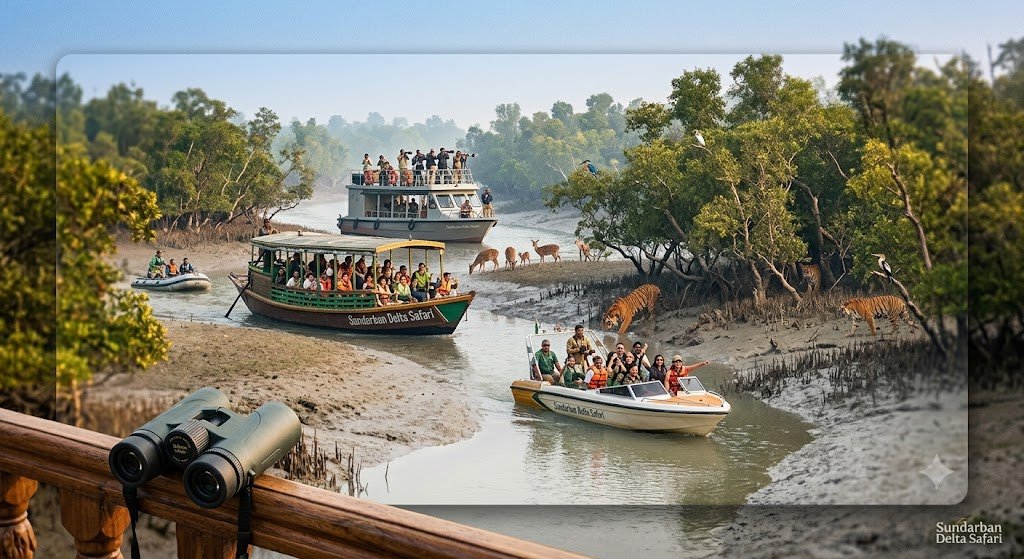
The Sundarban is one of the world's most remarkable mangrove regions, known for its Royal Bengal tigers, winding rivers, tidal creeks and rich biodiversity. What many travellers do not realise is that the Sundarban extends across two countries: India and Bangladesh. Both sides...

The Sundarban is one of the world's most remarkable mangrove regions, known for its Royal Bengal tigers, winding rivers, tidal creeks and rich biodiversity. What many travellers do not realise is that the Sundarban extends across two countries: India and Bangladesh.
Both sides share the same broad deltaic ecosystem, but their tourism routes, entry procedures, accommodation options and visitor experiences can differ. The Indian Sundarban is a popular nature destination for travellers from Kolkata, while the Bangladesh Sundarban is often explored through organised boat journeys from areas such as Khulna and Mongla.
If you are wondering whether the Sundarban in India is different from the Sundarban in Bangladesh, this guide explains their similarities, differences and travel arrangements.
The Sundarban lies in the Ganges–Brahmaputra–Meghna delta along the Bay of Bengal. It is a vast landscape of mangrove forests, rivers, tidal waterways and islands.
The Indian Sundarban is located in West Bengal, mainly within the southern part of the state. The wider region includes areas associated with South 24 Parganas and parts of North 24 Parganas.
Kolkata is the main gateway for many travellers. Visitors generally travel by road or train towards access points such as Canning, Godkhali or other designated boarding locations before continuing by boat.
The Bangladesh Sundarban is located in southwestern Bangladesh. Important gateway areas for organised trips include Khulna and Mongla.
Visitors commonly arrange road or other transport to the departure point and then continue by launch or another authorised vessel into the forest's waterways.
The two regions are ecologically connected, but they are governed by separate national authorities and tourism systems.
Source: UNESCO World Heritage Centre – Sundarbans National Park, India and The Sundarbans, Bangladesh.
| Feature | Indian Sundarban | Bangladesh Sundarban |
|---|---|---|
| Country | India | Bangladesh |
| Main gateway for many visitors | Kolkata | Khulna and Mongla |
| Common travel experience | Organised boat tours and short nature trips | Organised boat journeys, including longer launch trips |
| Famous wildlife | Royal Bengal tiger, spotted deer, crocodiles, birds and other wildlife | Royal Bengal tiger, spotted deer, crocodiles, birds and other wildlife |
| Landscape | Mangrove forests, tidal rivers, islands and creeks | Mangrove forests, tidal rivers, islands and creeks |
| Tourism arrangements | Indian tourism operators and applicable forest authorities | Bangladesh tourism operators and applicable forest authorities |
| Entry requirements | Indian forest permissions and applicable visitor rules | Bangladesh forest permissions and applicable visitor rules |
| International travel | Domestic travel for many Indian residents | International travel for Indian visitors, including applicable passport and visa requirements |
These are broad differences, not absolute rules. Both sides offer different trip lengths and accommodation arrangements, and the exact experience depends on the operator, route, season and current permissions.
The wider Sundarban is one of the world's largest mangrove ecosystems, extending across India and Bangladesh.
A substantial majority of the mangrove forest area lies in Bangladesh, with the remainder in India. UNESCO's descriptions indicate that approximately two-thirds of the wider mangrove forest is in Bangladesh, although exact percentages depend on the geographical area and measurement being discussed.
This does not mean that one side is necessarily better for every traveller. The total forest area, protected areas, accessible tourist routes and actual visitor experience are different measures.
The Indian and Bangladesh Sundarbans both contain extensive tidal waterways, mangrove vegetation and wildlife habitats.
Source: UNESCO – The Sundarbans.
Both sides support important wildlife habitats, including those used by the Royal Bengal tiger.
Wildlife found across the wider Sundarban region includes:
The exact species, their distribution and the likelihood of seeing them can vary by location and habitat.
Tiger habitat exists in both the Indian and Bangladesh Sundarbans. However, a tiger sighting is never guaranteed on either side.
Dense vegetation, waterways and the animals' natural behaviour make wildlife observation unpredictable. Visitors should follow official instructions and never ask guides or boat operators to disturb animals for a closer view.
There is no universal answer. The quality of a photography trip depends on the route, season, weather, access permissions, available viewing points and patience.
Neither country can guarantee that a visitor will photograph a tiger.
The two sides share a similar natural environment, but their tourism arrangements can create different experiences.
The Indian Sundarban is convenient for many travellers coming from Kolkata and other parts of West Bengal.
A trip may include:
Popular tourism locations associated with Indian Sundarban itineraries include Sajnekhali, Sudhanyakhali and Dobanki, subject to current access rules.
Official travel guidance is available through West Bengal Tourism.
Tourism on the Bangladesh side often involves organised boat journeys arranged through departure areas such as Khulna or Mongla.
Depending on the itinerary, visitors may experience:
Access to forest locations depends on permits, the vessel, current rules and the approved itinerary.
Official information and ticketing options are available through the Bangladesh Forest Department's Sundarban Eco-Tourism portal.
For many travellers starting in Kolkata, the Indian Sundarban is the more straightforward option because the trip does not normally require an international border crossing.
A typical journey may involve travelling towards Canning or another designated access point and then transferring to a boat.
The exact route depends on the package and boarding location.
An Indian traveller visiting Bangladesh must plan for international travel. This normally means checking passport validity, visa requirements and applicable entry conditions before departure.
The visitor must also arrange transport to the Bangladesh departure area and confirm the boat trip and required forest permissions.
Travel requirements can change, so check current official guidance before making reservations.
Practical advice: If you are planning a short weekend trip from Kolkata, compare the travel time and complete itinerary for an Indian Sundarban package against the longer arrangements needed for an international visit.
No. The wider ecological region is shared, but the designated tourism locations and visitor routes differ.
On the Indian side, commonly advertised locations include Sajnekhali, Sudhanyakhali, Dobanki, Burirdabri and other permitted destinations.
On the Bangladesh side, visitors may encounter different authorised forest stations, viewing locations and boat routes according to the operator and permissions.
It is important not to assume that a place accessible from one country can be visited directly from the other. Rivers and forest areas near the international border are subject to national regulations.
Before booking, request the complete itinerary and confirm which locations are actually included.
Accommodation and meals vary on both sides of the Sundarban.
Depending on the package, travellers may stay in a resort, hotel, lodge or homestay. Meals may include Bengali dishes featuring rice, fish, vegetables and other local preparations.
Some packages also include boat arrangements and local transfers.
Visitors can find organised boat journeys with accommodation and meals arranged according to the vessel and itinerary. Some trips are designed as multi-day launch experiences.
Facilities vary considerably by operator, so compare the actual arrangements rather than relying only on the words “luxury,” “premium” or “budget.”
For either country, confirm:
There is no reliable single answer because the overall cost depends on the visitor's starting point, travel documents, transport, trip duration, accommodation and package inclusions.
For an Indian traveller departing from Kolkata, an Indian Sundarban trip may involve fewer travel arrangements because international transport and visa procedures are generally not needed for a domestic visit.
A Bangladesh trip may involve additional transport and international travel costs for an Indian citizen, depending on the circumstances.
However, the price of a particular boat trip or accommodation can vary on either side. A basic trip in one country cannot fairly be compared with a premium multi-day launch journey in the other.
When comparing costs, calculate the complete trip rather than looking only at the advertised boat or accommodation price.
You should not assume that a tourist boat can cross between the two countries.
The Sundarban contains rivers and waterways close to the international border, but cross-border travel is subject to immigration, customs, vessel and other applicable permissions.
An ordinary domestic forest tour does not automatically include international travel.
If you wish to travel from India to Bangladesh, use the authorised international travel procedures and verify current requirements with the relevant authorities. Do not attempt to cross the border independently by boat.
The Sundarban ecosystem does not stop at the international border. Mangrove habitats, tidal processes and wildlife form part of a connected natural landscape.
Both countries face environmental challenges that can include:
Conservation requires cooperation, habitat protection, responsible tourism and attention to the communities that depend on the region.
UNESCO recognises the Indian and Bangladesh Sundarbans as separate World Heritage properties because each country has its own designated site and management framework. Both are part of the broader Sundarban ecological landscape.
Read more at the UNESCO World Heritage Centre and UNESCO's Bangladesh Sundarbans page.
The right option depends on your starting point, available time, budget and preferred travel experience.
Choose the Indian Sundarban if:
Consider the Bangladesh Sundarban if:
Neither side is automatically better for every visitor. Choose according to the experience you want and the arrangements you can comfortably manage.
Yes. The wider Sundarban mangrove region extends across West Bengal in India and southwestern Bangladesh.
A larger share of the wider mangrove forest lies in Bangladesh. UNESCO describes Bangladesh as containing approximately two-thirds of the forest area, although figures depend on the geographical boundaries and measurements used.
They are parts of the same broad ecological region, but they are administered by different countries and have separate protected-area and tourism arrangements.
For many Kolkata-based travellers, the Indian Sundarban is more straightforward because it is a domestic destination and does not normally require an international border crossing.
Tigers inhabit parts of both the Indian and Bangladesh Sundarbans. However, no tour can guarantee a tiger sighting.
Facilities depend on the specific destination, boat, accommodation and operator. Compare the complete itinerary and facilities rather than assuming one country is always better.
Indian citizens generally need the appropriate passport and Bangladesh visa or other applicable authorisation to enter Bangladesh. Check current official requirements before booking.
Not through an ordinary domestic forest tour. International movement requires the applicable immigration and other permissions.
Many species and ecological characteristics are shared across the region, although local habitats, species distribution and environmental conditions can differ.
Compare available tour packages, check the itinerary and inclusions, confirm the accommodation and boat arrangements, and review the final price and cancellation conditions before paying.
Conclusion: One Natural Region, Two Countries
The Sundarban in India and Bangladesh share an extraordinary mangrove ecosystem shaped by rivers, tides and coastal processes. Both sides are important for wildlife, local communities and conservation, but their tourism systems, access arrangements and visitor experiences differ.
For travellers starting in Kolkata, the Indian Sundarban is often the more convenient option for a short nature-focused holiday. Visitors interested in the Bangladesh side can plan an international trip after checking travel documents, permits and authorised tour arrangements.
If you want to explore the Indian Sundarban, visit Delta Safari's Sundarban tour packages. Compare the itinerary, accommodation, meals and inclusions before choosing a trip that suits your plans.